
Showing posts with label Dictionary. Show all posts
Showing posts with label Dictionary. Show all posts
Wednesday, 26 October 2011

A DICTIONARY OF SYMBOLS
A DICTIONARY OF SYMBOLS
by
J. E. CIRLOT
CONTENTS
FOREWORD page ix
INTRODUCTION xi
DICTIONARY 1
BIBLIOGRAPHY
OF PRINCIPAL SOURCES 387
ADDITIONAL BIBLIOGRAPHY 389
INDEX 401
by
J. E. CIRLOT
CONTENTS
FOREWORD page ix
INTRODUCTION xi
DICTIONARY 1
BIBLIOGRAPHY
OF PRINCIPAL SOURCES 387
ADDITIONAL BIBLIOGRAPHY 389
INDEX 401
| http://www.ziddu.com/download/11581738/onaryOfSymbols-New2010-www.freeinsurance.comxa.com.pdf.html |
Indian Medicinal Plants An Illustrated Dictionary - C.P. Khare
Indian Medicinal Plants An Illustrated Dictionary
- C.P. Khare

In 2004, Springer-Verlag Heidelberg published C.P.Khare抯 "Encyclopedia of Indian Medicinal Plants" which contained 400 monographs comprising classical as well as contemporary research findings.
"Indian Medicinal Plants. An Illustrated Dictionary" is the second major one-volume reference work by C.P.Khare which has been dedicated to the distinguished scientist, Dr. A.P.J.Abdul Kalam, who did pioneering work by reviving the glory of medicinal and aromatic plants in Rashtrapati Bhavan.
Scientific monographs of "The Wealth of India" series (17 volumes) have been capsulised in the dictionary and corroborated with the judicious findings of German Commission E, European Cooperative on Phytotherapy (ESCOP) and WHO. Therapeutic leads, active indications and contraindications are salient features of the core text. These are based on herbal pharmacopoeias, compendiums and latest editions of standard reference works like "PDR for Herbal Medicines," "(Laurance) Review of Natural Products", "Natural Medicines Comprehensive Database". Leads for further research have been provided at a number of places.
The Dictionary is the first updated source of Ayurvedic, Unani and Siddha synonyms of their botanical counterparts, after a gap of more than 30 years. The synonyms which appeared in "The Wealth of India" series (1948-1976) and in Chopra抯 "Glossary of Indian Medicinal Plants" (1956) have been updated till January, 2007.
More than 2000 medicinal plants of "The Ayurvedic Formulary of India" and "The Ayurvedic Pharmacopoeia of India" and more than 100 species of non-Indian origin, incorporated in "National Formulary of Unani Medicine" have been covered in the Dictionary. Divergent sources of Ayurvedic, Unani and Siddha herbs have been identified and a number of controversies have been sorted out.
Pharmacognosy experts have selected important herbs, which were specially collected from leading pharamaceutical companies and pharmacopoeial laboratories and included in the dictionary as four colour photographs under the "Crude Herb Identification Guide" section. This is a unique feature and makes it an exclusive treat.
The Dictionary has been presented in a user-friendly format, as a compact, handy, easy to use and moderately priced one-volume reference work. It unfolds hidden virtues and potentials of Indian herbs for busy professionals, researchers, practitioners of herbal as well as modern medicine, and library frequenters. It will prove a ready information source for students of botany, economic botany, pharmacy, agricultural and medical sciences, who aspire to have an edge over others and are keen to keep themselves abreast of the times.
DOWNLOAD LINK: Indian Medicinal Plants An Illustrated Dictionary - C.P. Khare
In 2004, Springer-Verlag Heidelberg published C.P.Khare抯 "Encyclopedia of Indian Medicinal Plants" which contained 400 monographs comprising classical as well as contemporary research findings.
"Indian Medicinal Plants. An Illustrated Dictionary" is the second major one-volume reference work by C.P.Khare which has been dedicated to the distinguished scientist, Dr. A.P.J.Abdul Kalam, who did pioneering work by reviving the glory of medicinal and aromatic plants in Rashtrapati Bhavan.
Scientific monographs of "The Wealth of India" series (17 volumes) have been capsulised in the dictionary and corroborated with the judicious findings of German Commission E, European Cooperative on Phytotherapy (ESCOP) and WHO. Therapeutic leads, active indications and contraindications are salient features of the core text. These are based on herbal pharmacopoeias, compendiums and latest editions of standard reference works like "PDR for Herbal Medicines," "(Laurance) Review of Natural Products", "Natural Medicines Comprehensive Database". Leads for further research have been provided at a number of places.
The Dictionary is the first updated source of Ayurvedic, Unani and Siddha synonyms of their botanical counterparts, after a gap of more than 30 years. The synonyms which appeared in "The Wealth of India" series (1948-1976) and in Chopra抯 "Glossary of Indian Medicinal Plants" (1956) have been updated till January, 2007.
More than 2000 medicinal plants of "The Ayurvedic Formulary of India" and "The Ayurvedic Pharmacopoeia of India" and more than 100 species of non-Indian origin, incorporated in "National Formulary of Unani Medicine" have been covered in the Dictionary. Divergent sources of Ayurvedic, Unani and Siddha herbs have been identified and a number of controversies have been sorted out.
Pharmacognosy experts have selected important herbs, which were specially collected from leading pharamaceutical companies and pharmacopoeial laboratories and included in the dictionary as four colour photographs under the "Crude Herb Identification Guide" section. This is a unique feature and makes it an exclusive treat.
The Dictionary has been presented in a user-friendly format, as a compact, handy, easy to use and moderately priced one-volume reference work. It unfolds hidden virtues and potentials of Indian herbs for busy professionals, researchers, practitioners of herbal as well as modern medicine, and library frequenters. It will prove a ready information source for students of botany, economic botany, pharmacy, agricultural and medical sciences, who aspire to have an edge over others and are keen to keep themselves abreast of the times.
DOWNLOAD LINK: Indian Medicinal Plants An Illustrated Dictionary - C.P. Khare


A Dictionary of Neurological Signs by Andrew J. Larner
A Dictionary of Neurological Signs
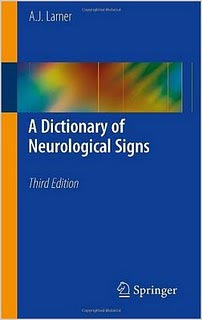

by Andrew J. Larner
The Dictionary of Neurological Signs can be almost as well described in terms of what the book is not, along with details about what it is. The Dictionary is not a handbook for treatment of neuropathies. While many entries provide the latest treatment options, up-to-the-minute therapies are not discussed in bedside level detail. The Dictionary is not a board review book because it is not in Q&A format but could easily serve in that capacity since each entry is a fairly complete snapshot of a specific disorder or disease. The Dictionary is an alphabetical listing of commonly presenting neurological diseases and disorders designed to guide the physician toward the correct clinical diagnosis. The content is focused, problem-based, concise and practical. The structured entries in this practical, clinical resource provide a thumbnail of a wide range of neurological signs. Each entry includes: • definition of the sign • a brief account of the clinical technique required to elicit the sign • description of the other signs which may accompany the index sign • explanation of pathyophysiological and/or pharmacological background • differential diagnosis • brief treatment details. Where known, the entries also include neuroanatomical basis of the sign. The Dictionary provides practical, concise answers to complex clinical questions.

Subscribe to:
Posts (Atom)
